> For the complete documentation index, see [llms.txt](https://docs.balkan.id/llms.txt). Markdown versions of documentation pages are available by appending `.md` to page URLs; this page is available as [Markdown](https://docs.balkan.id/user-access-reviews/access-review-management/tracking-campaigns-and-performing-access-reviews/campaign-dashboard-and-management.md).
# Campaign dashboard and management
## Campaign Dashboard
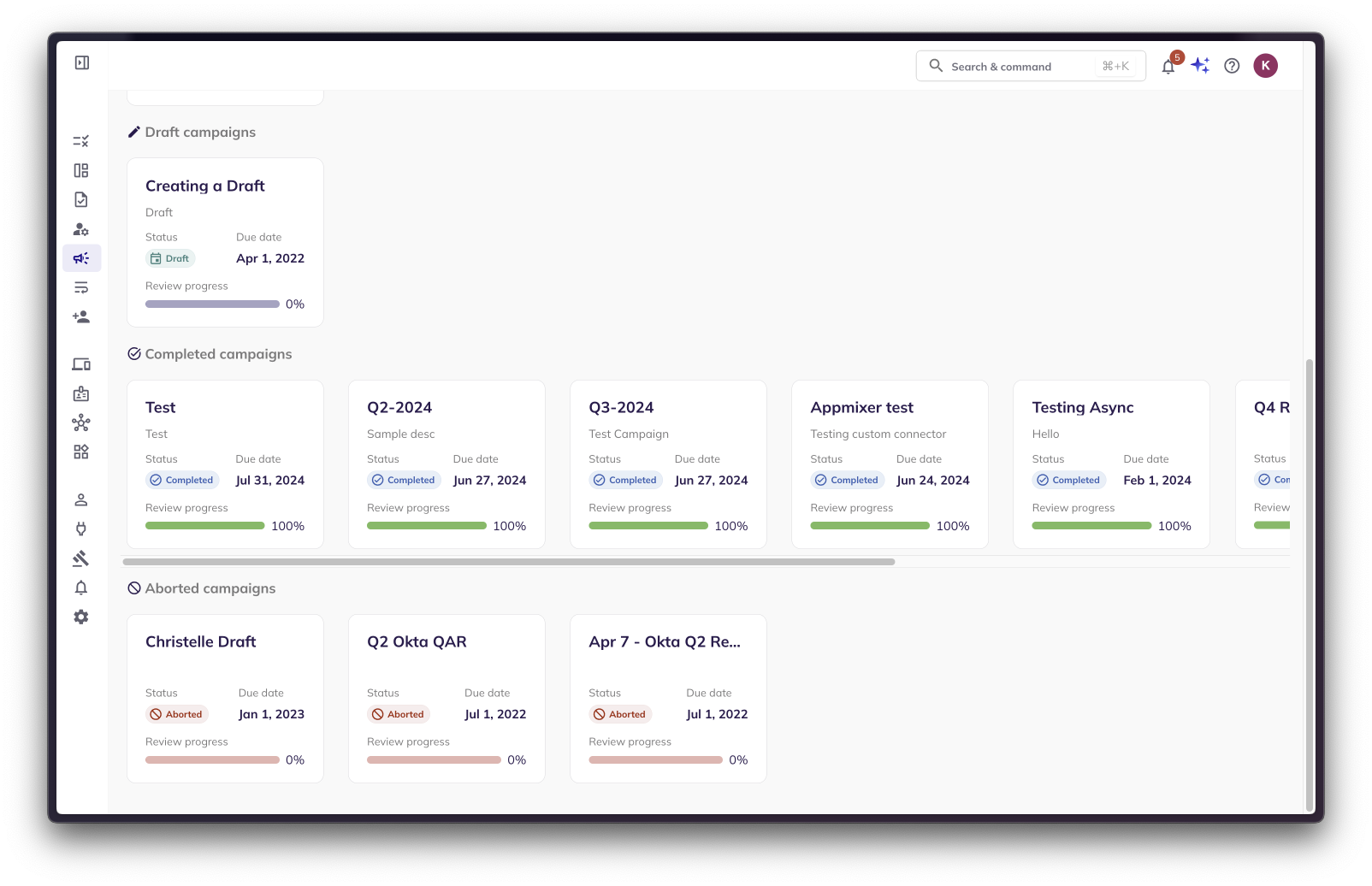
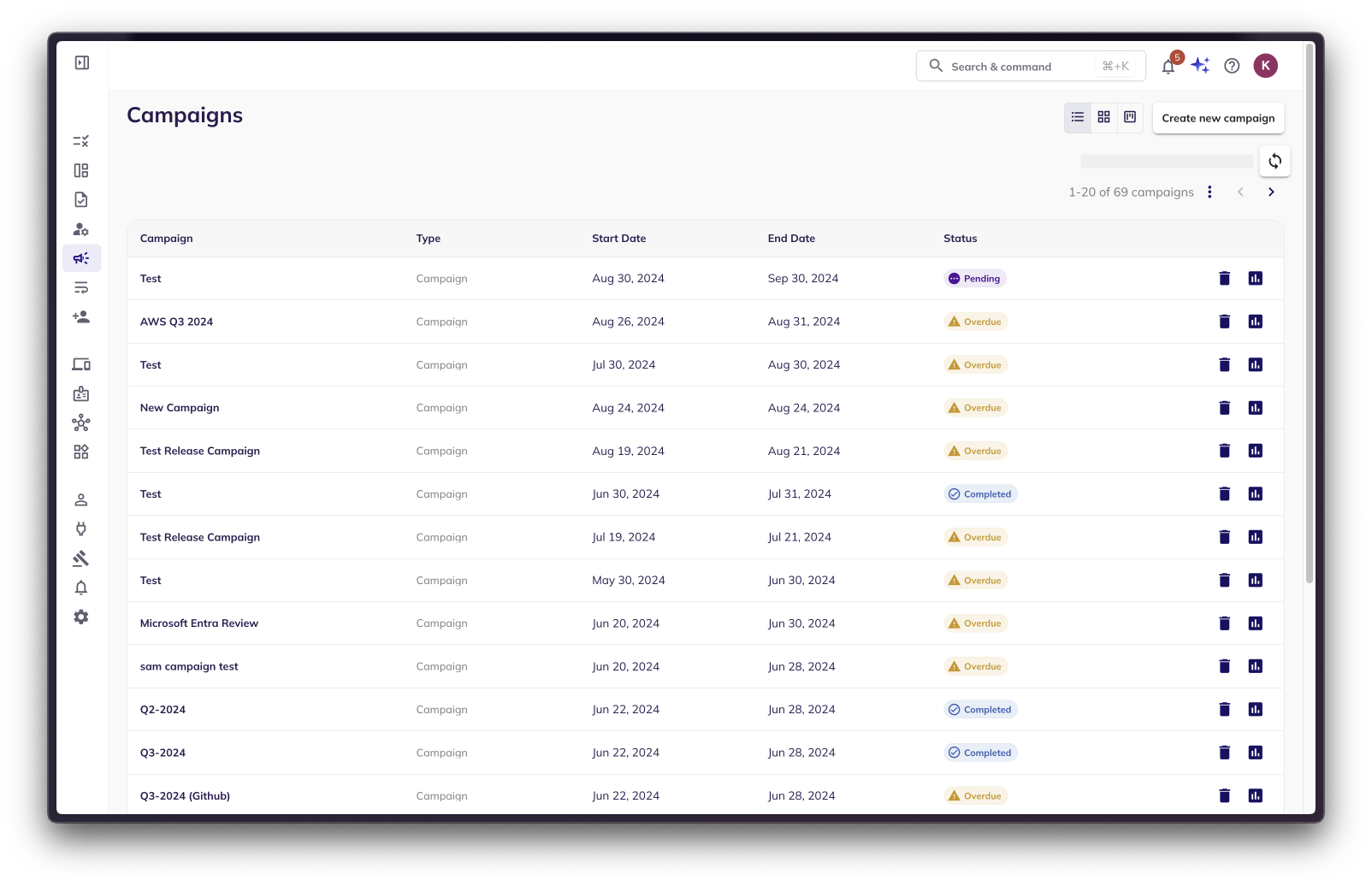
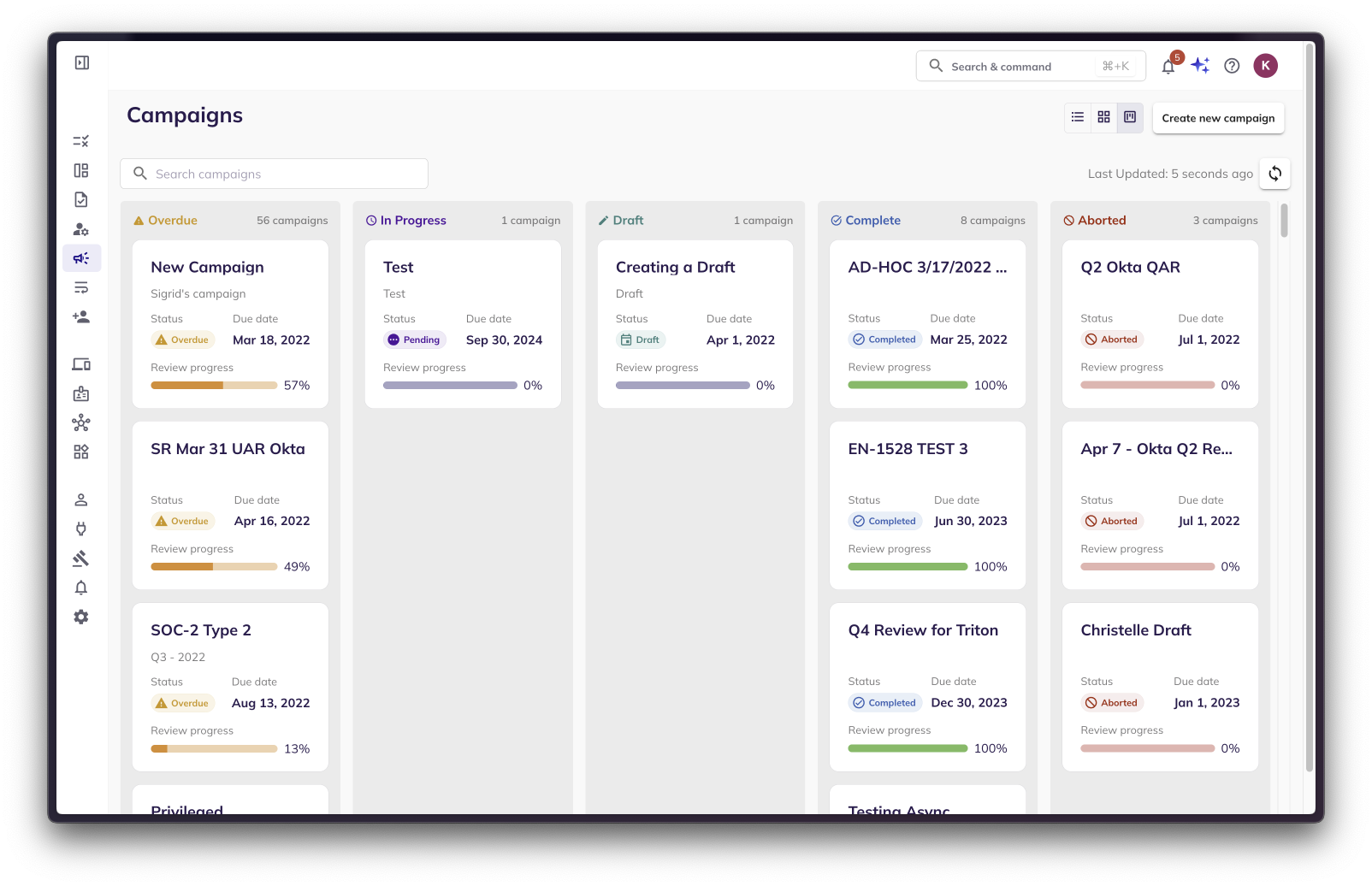
Once a campaign is created, **Administrators** and **Risk Managers** can review the progress of all campaigns via the main campaign dashboard. Campaigns are broken up into the following sections: *Draft*, *In-progress*, *Overdue*, *Completed* and *Aborted*. We have three different views for campaigns:
* **Grid**:
* **List**:
* **Kanban**:
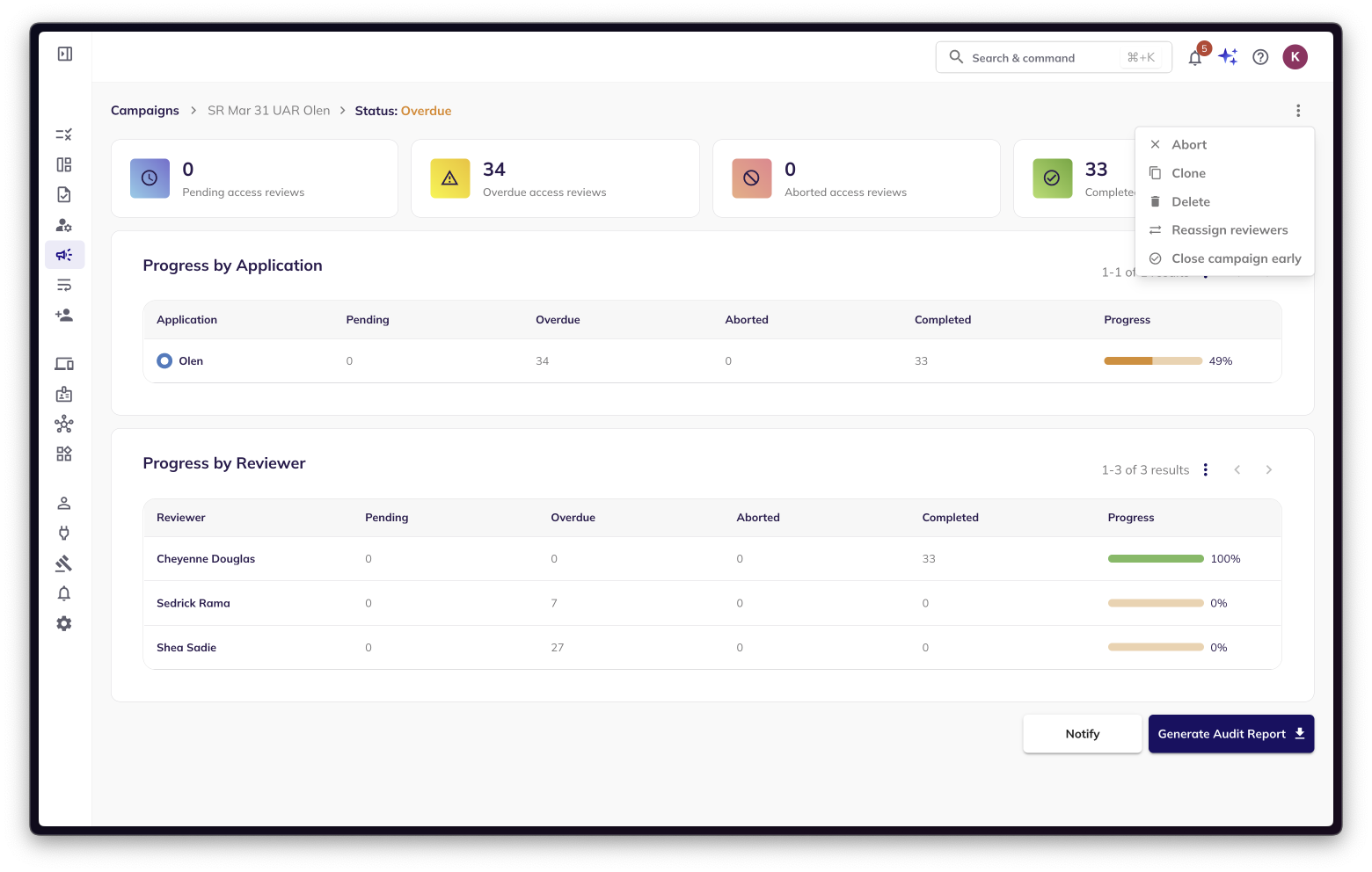
Clicking on a campaign will give you details on the campaign progress by application and reviewer respectively. The dashboard is composed of the following sections:
1. **Basic Information** - Essential campaign information about creation date, campaign period, escalation configuration, and reviewer levels and precedence order.
2. **Summary** - The status of all access reviews for that given campaign
1. *Pending* - Access reviews that are pending to be reviewed, but within the due date of the campaign
2. *Overdue* - Access reviews that have not yet been completed and are past the due date of the campaign
3. *Aborted* - Access reviews that have been prematurely stopped for a particular reason by the admin.
4. *Completed* - Access reviews that have been reviewed and have reached a final state (Denied or Approved)
3. **Progress by Application (Integration)** - A table summary of the current progress of access reviews by each individual application. You will be able to sort and filter by application integrations.
4. **Progress by Reviewer** - A table summary of the current progress of access reviews by each individual reviewer. You will be able to sort and filter by reviewer names.
5. **Progress by Resource** - A table summary of the current progress of access reviews by each individual resource. You will be able to sort and filter by resources.\
Further, you can click on the data in the table such as *Application name*, *reviewer name* or even the number of items under *Pending*, *Overdue*, *Aborted* statuses etc, to be taken to a detailed page of all the reviews in those buckets (**For example,** under *Okta*, clicking on the number 8 that is *Pending* will take you to that specific filtered page to show what is *Pending* within the Okta application for this specific campaign).
***
### View Sync Evidence
{% hint style="info" %}
This feature is currently in **Early Access**.
{% endhint %}
The campaign **Summary** page includes a **View Sync Evidence** button near the bottom of the page.
Use it to inspect the historical integrations sync snapshot captured when the campaign was created.
The dialog can show:
* the campaign creation filter (used during campaign creation to scope what should be reviewed in the campaign)
* one sync card for each integration included in the campaign
* the captured sync status, timestamps, and status message — as they were at the time of campaign creation.
* any audit evidence notes and attached files captured with those syncs
This is a read-only view. It does not update when newer integration syncs run later, since it captures completed integration syncs and their attachments at time of campaign creation.
For the full workflow, see [Audit evidence and sync history](/getting-started/setting-up-your-tenant/application-integrations/audit-evidence-and-sync-history.md).
***
### Comments
Campaign summary tables include an aggregated view of comments across reviews in the campaign. This helps admins and risk managers spot active discussions quickly.
#### Viewing Comments Across Campaign Summaries
Campaign summary tables let you view comments across multiple reviews at once, grouped by Resource, Integration, or Reviewer.
To view these comments, click the comment icon in the *Comments* column for any row in a campaign summary table. This opens the *Aggregated Comments* side panel.
#### Using Aggregated Comments
Aggregated comments let you review discussions across multiple access reviews in one place. You can **page through all related comments** directly from the panel and see the **exact entitlement relationship** each comment applies to (for example, *User → Group → Resource*). When a comment needs follow-up, use **View Review** to jump straight to the underlying review and continue the discussion in context.
{% hint style="info" %}
The aggregated comments view is read-only. To add or reply, open the review using **View Review**.
{% endhint %}
### Actions on Campaigns: Managing Your Access Reviews
By clicking the **three dots** located in the top right corner of a campaign card or within the campaign's detail view, you'll unlock a suite of available actions.
### Actions Available for Draft Campaigns
When a campaign is in a **Draft** state, it means it's still being set up and is not yet active. Here are the actions you can take:
* **Publish:** This action makes your campaign **active and initiates the access review process**. Reviewers will begin receiving notifications and can start actioning on their assigned reviews. You can track the status of publishing through the snackbar.
* **How to Publish:**
* **From the Campaign Dashboard:** Click the action's menu on the campaign card and select "*Publish*."
* **From the Edit Page:** While editing a draft campaign, you'll find a "Publish" option to activate it directly.
* Once you click **Publish** using either of the options above, a confirmation dialog will appear.
This dialog asks you to confirm that you want to publish the campaign. It will also alert you if any integrations used in the campaign are **out of sync**, meaning the data may not be fully up to date. If all integrations are in sync, you’ll see a simple confirmation dialog with no warnings.
* **Edit:** This action allows you to **modify the campaign's configuration**, including filters, review details, reviewers, and fulfilment options, before it goes live.
* **Abort:** This action immediately stops a campaign and halts all associated access reviews. All review statuses will be updated to "**Aborted**."
* **Delete:** This action permanently removes the campaign and all its associated data. Once a campaign is deleted, all review data, history, and configuration related to that campaign are irretrievably lost.
* **Difference from Abort:** An aborted campaign preserves its data with an "Aborted" status, allowing you to review its history. Deleting a campaign erases all its historical data.
* **Reassign reviewers:** The *Reassign reviewers* action is used to reassign access reviews to a different reviewer. Select the current reviewer(s), then select the new reviewer..
***
### Actions Available for Published Campaigns
Once a campaign is **Published**, it is actively running and reviewers are working on their assigned tasks.
* **Abort:** This action immediately stops a campaign that has been published but hasn't fully completed. This action halts all associated access reviews. Any access reviews within that campaign that have not yet been approved or denied will have their status updated to "**Aborted**."
* **Note:** Once a campaign is aborted, no further de-provisioning, ticket creation, or notification sending will occur for any review from that campaign, regardless of its prior status.
* **Clone**: The *Clone* action creates a duplicate version of the selected campaign and is saved as a *Draft* campaign. All the reviews and data is duplicated. This campaign will need to be published to perform reviews.
* **Delete**: This action permanently removes the campaign and all its associated data. Once a campaign is deleted, all review data, history, and configuration related to that campaign are irretrievably lost.
* **Difference from Abort:** An aborted campaign preserves its data with an "Aborted" status, allowing you to review its history. Deleting a campaign erases all its historical data.
* **Reassign reviewers:** The *Reassign reviewers* action is used to re-assign access reviews to a different reviewer. You can select whose reviews would you like to re-assign and to whom.
* **Close campaign early**: The *Close campaign early* action closes the campaign before completion. You can perform the following actions when you close a campaign early:
* You can *Reassign and Approve* them
* You can *Reassign and Deny* them
* You can view all reviews belonging to this campaign before approving or denying all of them. This will take you to the *Access Reviews* page to see the reviews which are still *In-progress.*
***
### Actions Available for Completed Campaigns
Once all reviews within a campaign have been actioned upon, it transitions to a state where final processing can occur.
* **Complete**: This action is used to complete a campaign once all the reviews within the campaign have been actioned upon. This marks the end of the campaign and signifies that no more changes can be made on the reviews belonging to this campaign. Once the campaign is complete, all de-provisioning, notifying and ticket creation processes will be undertaken depending on the fulfilment options set for the integrations. You can learn more about these processes [here](/user-access-reviews/access-review-management/tracking-campaigns-and-performing-access-reviews/understanding-review-statuses.md).
* **Clone**: The *Clone* action creates a duplicate version of the selected campaign and is saved as a *Draft* campaign. All the reviews and data is duplicated. This campaign will need to be published to perform reviews.
* **Delete**: This action permanently removes the campaign and all its associated data. Once a campaign is deleted, all review data, history, and configuration related to that campaign are irretrievably lost.
---
# Agent Instructions
This documentation is published with GitBook. GitBook is the documentation platform designed so that both humans and AI agents can read, navigate, and reason over technical content effectively. Learn more at gitbook.com.
## Querying This Documentation
If you need additional information that is not directly available in this page, you can query the documentation dynamically by asking a question.
Perform an HTTP GET request on the current page URL with the `ask` query parameter, and the optional `goal` query parameter:
```
GET https://docs.balkan.id/user-access-reviews/access-review-management/tracking-campaigns-and-performing-access-reviews/campaign-dashboard-and-management.md?ask=&goal=
```
`ask` is the immediate question: it should be specific, self-contained, and written in natural language.
`goal` is optional and describes the broader end goal you are ultimately trying to accomplish on behalf of the user. GitBook uses it to tailor the answer towards what is most useful for that goal.
The response will contain a direct answer to the question and relevant excerpts and sources from the documentation.
Use this mechanism when the answer is not explicitly present in the current page, you need clarification or additional context, or you want to retrieve related documentation sections.