> For the complete documentation index, see [llms.txt](https://docs.balkan.id/llms.txt). Markdown versions of documentation pages are available by appending `.md` to page URLs; this page is available as [Markdown](https://docs.balkan.id/getting-started/setting-up-your-tenant/application-integrations/direct-application-integrations/hubspot-integration-setup.md).
# HubSpot Integration Setup
### Getting Started
Use this guide to connect HubSpot to your BalkanID tenant. You will need a private app access token from your HubSpot account and access to the Integrations section in BalkanID.
#### Requirements:
Before you begin, collect the following value from HubSpot:
* **Private App Access Token**
### Configure HubSpot within your BalkanID tenant
1. In BalkanID, go to the **Integrations** page and click **Add integration**.
Add integration
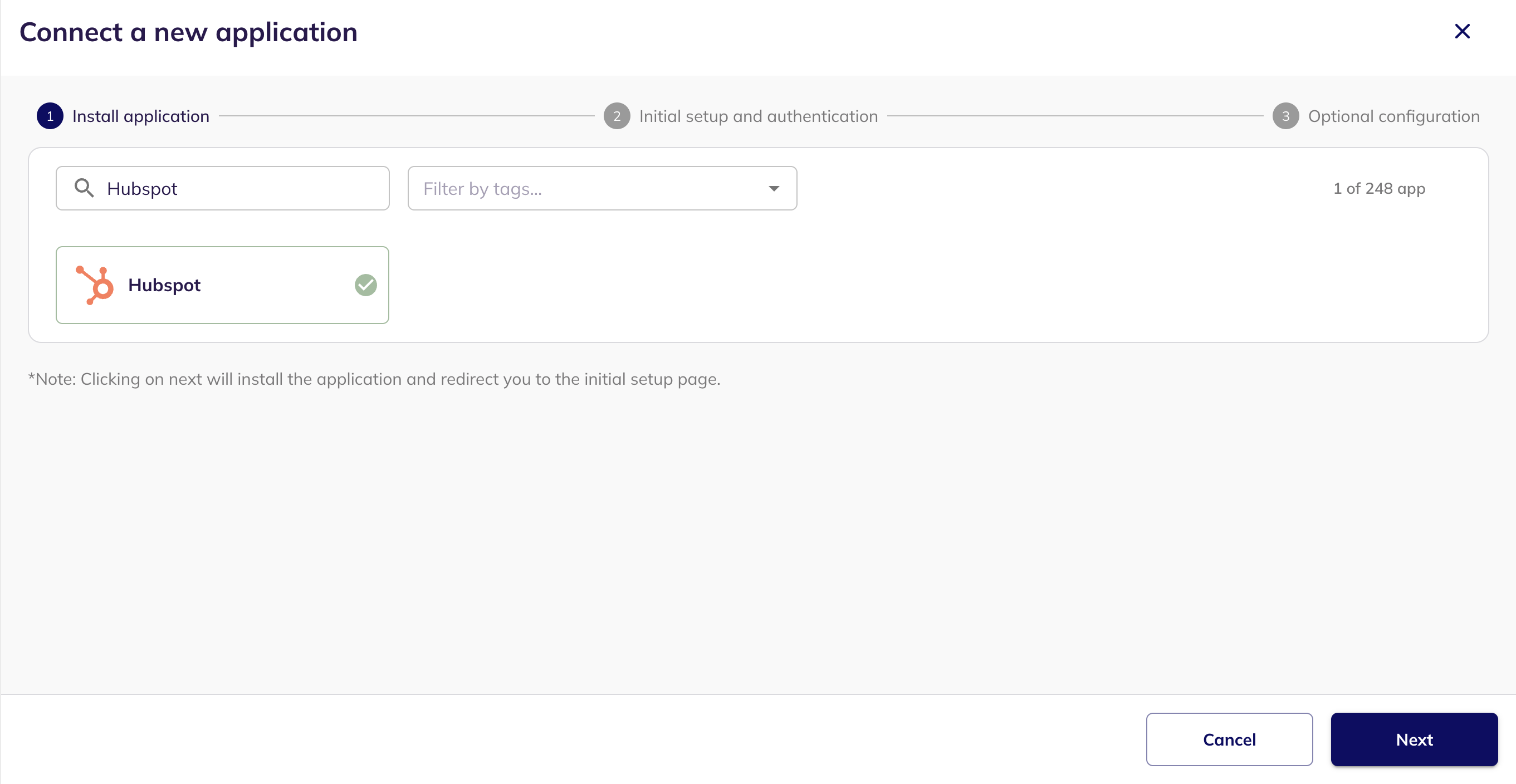
2. Search for HubSpot and select it in **Connect a new application**, then click **Next**.
Connect a new application
3. To create the access token, sign in to HubSpot as a Super Admin and click the settings icon in the main navigation bar.
4. In the left sidebar menu, navigate to **Integrations > Private Apps**, then click **Create private app**.
5. On the **Basic Info** tab, give the app a name such as `BalkanID`.
6. On the **Scopes** tab, enable the scopes listed under [Integration Scopes](#integration-scopes) below.
7. Click **Create app**, then confirm to reveal the token. Copy the access token, which begins with `pat-`.
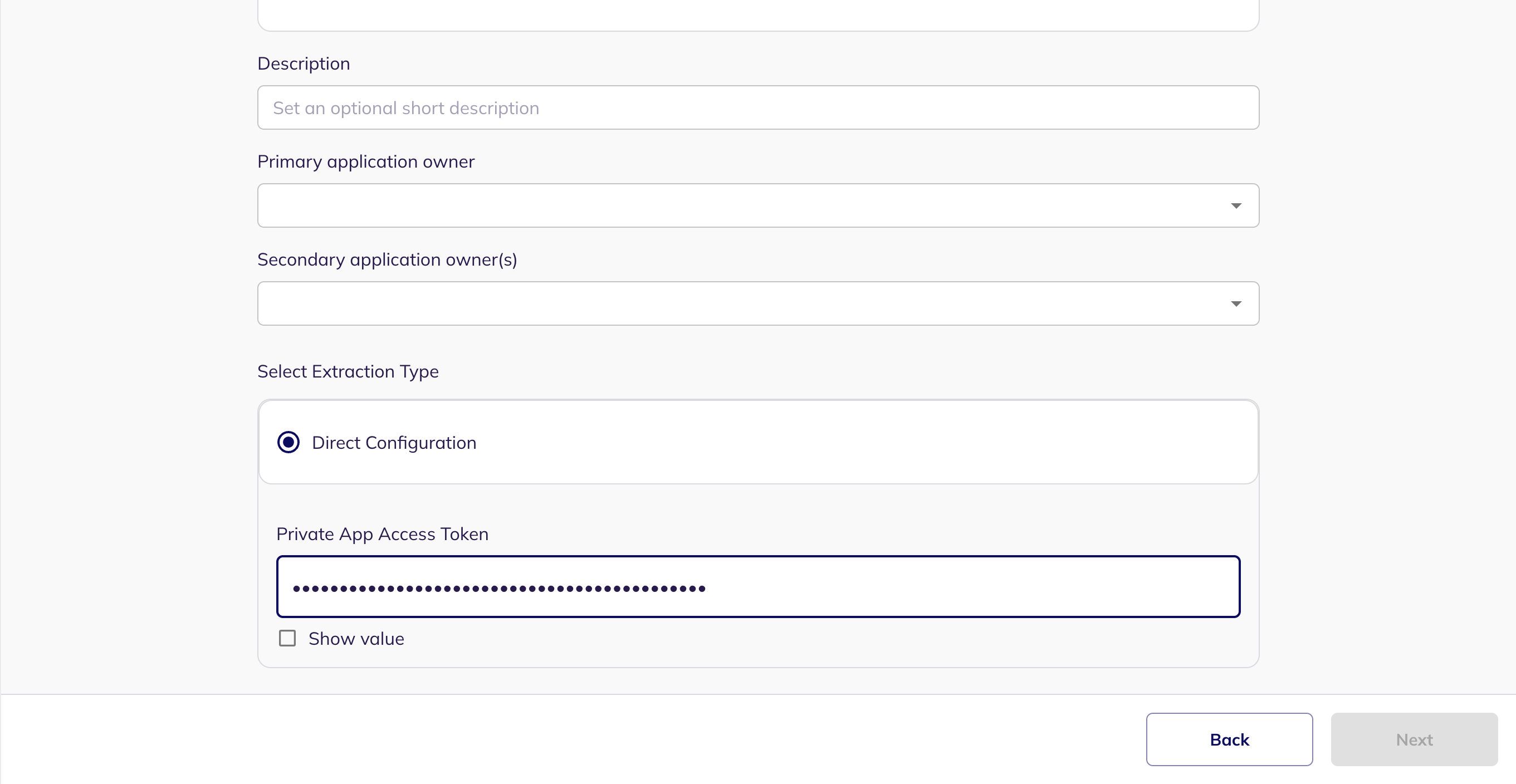
8. In BalkanID, paste the token into the **Private App Access Token** field under **Direct Configuration**, then click **Next.**
Direct Configuration
9. Click Next to move onto Optional Configuration.
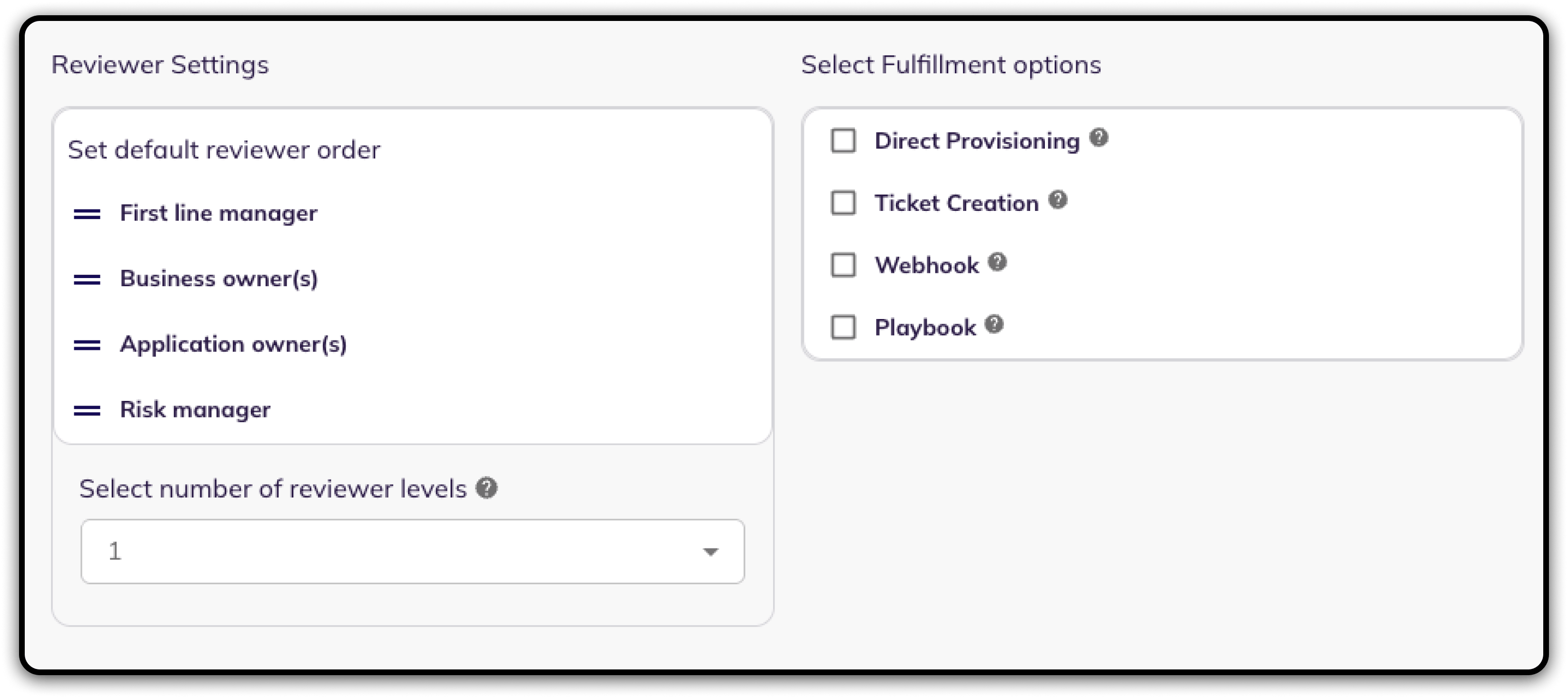
10. Fill **Optional Configuration**, if required.
Optional Configuration
11. Once you have filled in the information, click **Save**. Your integration is now configured and you will see the status of the integration displayed alongside other integrations on the Integrations page. When data is available, the integration Status column will read **Connected** and the integration Message will read **Data available**.
### Integration Scopes
| Read Only Scopes | Lifecycle Management Scopes |
| --------------------------------------------------------------------------------------------------------------------------------------- | --------------------------- |
| **Users (Read)** — `settings.users.read`, covering account users and the permission sets assigned to them | N/A |
| **Teams (Read)** — `settings.users.teams.read`, covering teams and their membership | N/A |
| **Owners (Read)** — `crm.objects.owners.read`, used to determine whether a user is active or deactivated, and when the user was created | N/A |
{% hint style="info" %}
Teams are available on HubSpot Professional and Enterprise accounts. On other plans, BalkanID syncs users and permission sets, and the teams portion of the sync is skipped automatically.
{% endhint %}
---
# Agent Instructions
This documentation is published with GitBook. GitBook is the documentation platform designed so that both humans and AI agents can read, navigate, and reason over technical content effectively. Learn more at gitbook.com.
## Querying This Documentation
If you need additional information that is not directly available in this page, you can query the documentation dynamically by asking a question.
Perform an HTTP GET request on the current page URL with the `ask` query parameter, and the optional `goal` query parameter:
```
GET https://docs.balkan.id/getting-started/setting-up-your-tenant/application-integrations/direct-application-integrations/hubspot-integration-setup.md?ask=&goal=
```
`ask` is the immediate question: it should be specific, self-contained, and written in natural language.
`goal` is optional and describes the broader end goal you are ultimately trying to accomplish on behalf of the user. GitBook uses it to tailor the answer towards what is most useful for that goal.
The response will contain a direct answer to the question and relevant excerpts and sources from the documentation.
Use this mechanism when the answer is not explicitly present in the current page, you need clarification or additional context, or you want to retrieve related documentation sections.